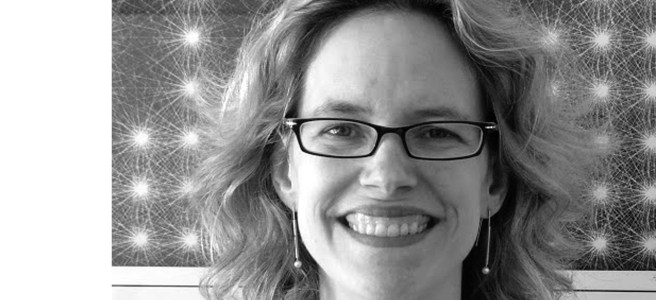
J’avoue une admiration sans bornes pour l’écrivain, conservateur au Design Musem de New-York et graphiste Ellen Lupton, j’en ai déjà parlé sur un billet précédent. Aujourd’hui je vous fais part de ses autres blogs et notamment de Design you life, qui traite du design et plus particulièrement du design fait soi-même (Design It Yourself, DIY) comme, je cite, « un mode de pensée et d’action qui peut être mis en application dans les situations de tous les jours ». Tous les « designs » y sont abordés, graphic design, fashion design, techno design, eco design, diy design… pour notre plus grand plaisir.
Visitez ensuite son autre site Design writing research et plus particulièrement la catégorie Essays où Ellen traite des sujets divers et variés autour du design allant de la déconstruction aux femmes dans le graphisme, mais aussi d’architecture, en passant par la typographie fluide ; je n’ai pas tout lu, mais tous les sujets font envie.
Attardez-vous dans la section Free Font Manifesto où la graphiste s’interroge avec d’autres designers sur la nécessité et les dangers des fontes distribuées en Open Source.
Puis pour finir son blog dédié au design pour et par les enfants : Do It Yourself Kids
Une interview d’Ellen Lupton, via Design Hub
Ellen Lupton – design zealot
by Nicole Bearman and Gabrielle Eade
Design communicator, and communication designer extraordinaire Ellen Lupton talks to Design Hub about the new National Design Triennial at Cooper-Hewitt, National Design Museum, and her personal quest to open up design to the broadest possible audience.
What are you working on at the moment?
My big interest right now is the opening up of the design discourse to the broader public. We are seeing this everywhere. The rise of the Internet has given people access to more tools and more information. Over the past four years, blogging and other « social media » have become especially powerful. At the same time, people are becoming more engaged with physical making – craft, knitting, D.I.Y. technologies. I published a book with my graduate students in 2004, called D.I.Y.: Design It Yourself, and I’m really excited about this line of discourse: addressing the public as designers. My next book is D.I.Y. Kids, featuring design work by children.
You define yourself as a writer, curator and graphic designer. What really excites you in your work and what are your ultimate goals?
I am excited about bringing people – all kinds of people – into design. I’ve become a bit of a zealot, a passionate church lady, but my church is the discourse of design, which has become an increasingly public, open discourse. I love to teach, and I’m teaching professional designers at the graduate and undergraduate levels at Maryland Institute College of Art, where I am director of the graduate program in graphic design. I also do workshops and lectures for everyday people, which is a different kind of teaching.
How has your career path evolved?
I studied design and art in the early 1980s at The Cooper Union in New York City. When I graduated, I was invited to run a small design gallery inside the school. I did that for seven years. I was a do-it-yourself curator, hanging my own shows, keeping the windows clean, trimming the labels. At the same time, I was publishing a lot, building a reputation as a writer and critic. In 1992, I was offered a ‘real job’ at Cooper-Hewitt, National Design Museum, also in New York City. Now, I had the opportunity to create much larger exhibitions for a bigger public. Each exhibition has been accompanied by a sturdy exhibition catalogue and ambitious public programming. I’ve also had the chance to work with amazing colleagues – great design thinkers. In 1997, I was invited to run the graphic design program at Maryland Institute College of Art, in Baltimore, a big, tough city that is two hours by train from New York. Baltimore is my hometown, and a fun place to live. Cooper-Hewitt has allowed me to live in Baltimore for the past ten years and continue as a part-time curator. It’s a hectic, sometimes scattered lifestyle that allows me to do all the things I want to do (and more!).
What attributes do you think you possess that have helped you succeed in this field?
I love to get things done. I love to get up early and start working. I love to see a project come into completion. I think that my fundamental enjoyment of doing, making, and writing has allowed me to be a highly effective person. I take genuine pleasure in communicating ideas in a way that people will understand. Whereas some scholars or critics are primarily interested in addressing their peers, I want to be understood by as many people as possible. Design is about communication, and I love to communicate.
Your website appears to be a testing ground for ideas and a place for discussion. Does this forum work?
My main web site, designwritingresearch.org, is primarily a way for me to communicate outward to the world. It’s an archive of my writing, and it’s a tool I use in all my teaching and workshops. I also have a blog that I edit with my sister, Julia Lupton, design-your-life.org. Our blog is an open medium. Anyone can contribute a post about design and living, and we have a small but avid following. People write about fashion, celebration, housekeeping, child-rearing, politics, and media. We also have a blog about design for kids, d-i-y-kids.blogspot.com.
Can you explain your curatorial approach to the 2006 National Design Triennial and the theme you have chosen?
Design Life Now: National Design Triennial was organised by a team of curators: Barbara Bloemink, Matilda McQuaid, Brooke Hodge, and myself. The exhibition is open through July 2007. We all brought our special interests and expertise to the curatorial table. I was especially interested in the rise of social media and do-it-yourself design movements during the past three years – again, the opening up of the design discourse to more voices. For example, the Triennial features Processing, a free, open-source computer language created for visual artists. Processing is not so much a finished design artifact as a tool that anyone can use. The Triennial web site has a blog; visit us at peoplesdesignaward.org/designlifenow.
What have been the key trends in American design since your last Triennial in 2003?
The last Triennial reflected a post-9/11 atmosphere. Called Inside Design Now, it focused on the interior-on handcraft, pattern, texture, and making. Craft continues to be a big part of design today, but what’s changing is the movement outward. Design is becoming less inwardly directed and more socially directed. Magazines such as ReadyMade and Make, both featured in the Triennial, invite people to engage in design activities. Designers are working in collaborative teams. They are creating furniture, textiles, and spaces that encourage conversation.
In your opinion, what characteristics define contemporary American design? And how does it fit in a global design economy?
American design is a huge and diverse phenomenon, and the Triennial doesn’t try to pin it down so much as give a picture of a big, messy, mixed affair, which ranges from high-tech military equipment and space-age robots to a vase made of PlayDough and a hand-beaded purse. A product like the iPod is designed in California but manufactured in China.
What inspired you to initiate the free font manifesto? Were you surprised by the response you received to the concept of free fonts?
Given my interest in ‘open’ design, I wanted to find out if there was an open-source movement in the typeface design community, which is a particular subculture within the broader graphic design world. Typeface designers have always been protective of their intellectual property, because fonts are so easy to steal and there is a huge problem with piracy. I had been invited to address typeface designers and typographers at an international design conference, so I decided to explore the topic of ‘free fonts’. I created a blog to accompany my talk – a new experiment for me. Given the controversial nature of the topic, I wanted to get feedback from my audience beyond the usual Q&A session after the talk. And feedback I certainly got! News of the blog spread like wildfire, and a heated debate ensued on-line. I learned a lot, not only about the passions and worries of the font design community but also about the nature of online communication.
Where do you hope the flourishing D.I.Y. revolution will lead us?
I’d like to see design education become part of general education, from kindergarten up through graduate school. Learning to communicate online and in print are basic life skills that empower citizens and connect them to all kinds of communities, global and local. Gutenberg’s revolution opened up reading to a bigger public, and eventually the idea of ‘universal literacy’ was born. Today, to be literate involves not only reading/receiving, but also making/producing in a range of media. It’s not enough to be in the audience any more.

What are the big challenges facing designers in the 21st century?
As the design discourse opens up, professional designers will shape the discourse by creating better and better tools and environments for public communication. (I am speaking here primarily of graphic design.) The biggest challenge facing all the design fields is the global environment. How can we create objects, systems, places, and tools that will help reverse the degradation of the world? This challenge, too, demands that the public be involved. The problem can’t be solved by designers alone, but requires changes in how people live.
What is your philosophy, in life and design?
These are a few principles borrowed from my blog, design-your-life.org. I like these principles because anyone can use them, not just professional designers.
ORDER – Use design to organize and improve your environment at home, at work, and in the world.
OPPORTUNITY – Use design to expand your expressive, economic, and social horizons.
PRODUCE MORE, CONSUME LESS – Design it yourself using digital tools and craft skills.
How do you relax and play?
I love to cook, and I love to hang out with my gorgeous kids and husband. But work is play for me, too. Nothing thrills me more than being involved in a great book or web project. Authorship gets me going.










 lemodalogue.com