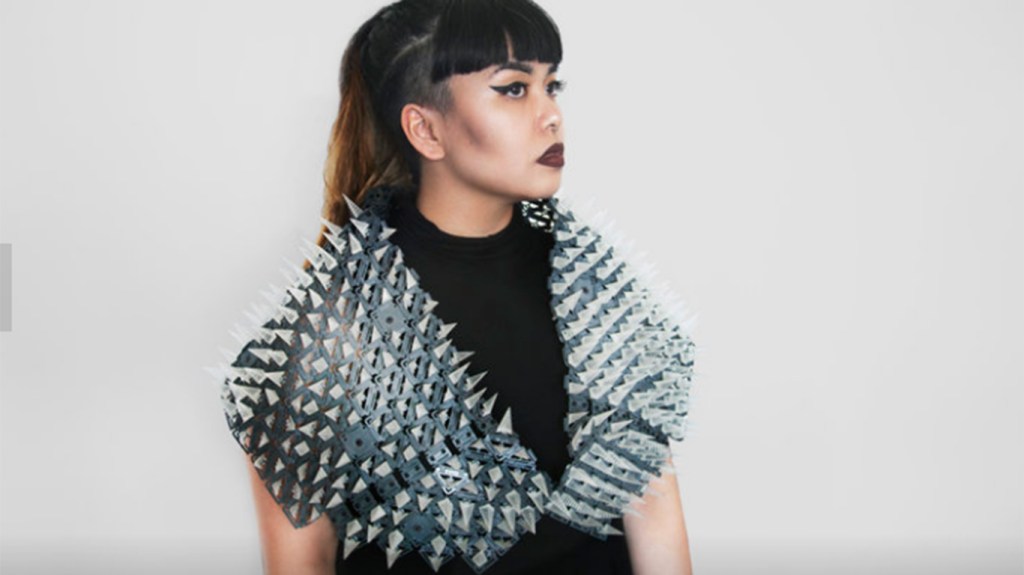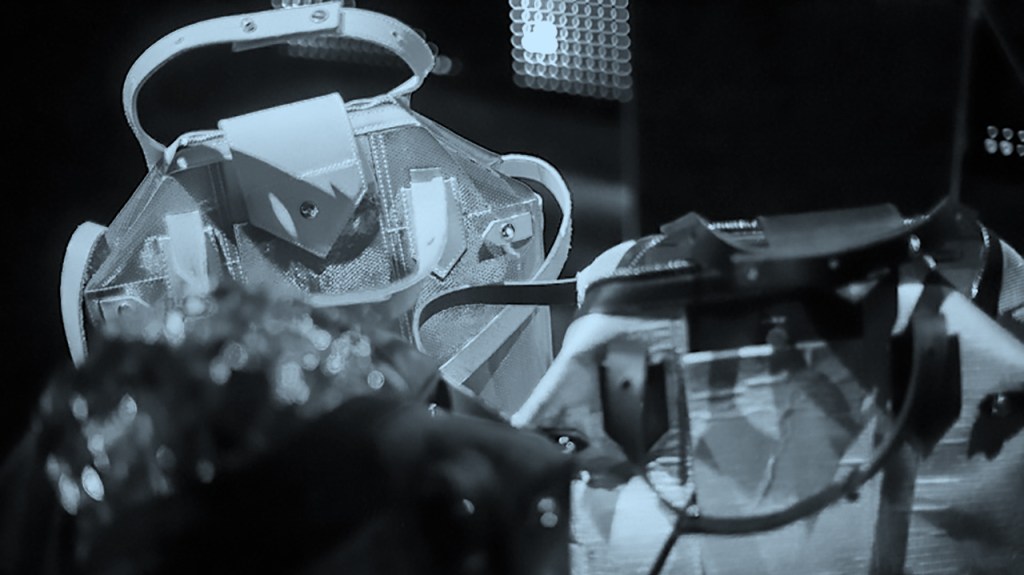
BELOW, AMANDA YAMASAKI’S 3D PRINTED THERMOCHROMIC GARMENT
Garment Software Demo from Amanda Yamasaki on Vimeo.
BELOW, AMANDA YAMASAKI’S 3D PRINTED THERMOCHROMIC GARMENT
Garment Software Demo from Amanda Yamasaki on Vimeo.
Nicolas Theil, wearing own designed glasses (3D printed by himself)
Dear readers,
my friend Harvey Ambomo, a real dandy, always sports edgy accessories and especially very beautiful bags, told me months ago, about Nicolas Theil, the brilliant creator of these leather goods.

Nicolas Theil showed earlier this month at W Paris Opéra his new summer/spring 2013-2014 collection « Floraison radioactive ». As expected the collection is gorgeous.
During the little interview, I discover a very pleasant, enthusiastic and funny guy. His presentation starts in a iconoclastic way with his friends giggling, passing through the audience wearing big glasses and fluorescent yellow anti-radiations outfits (see below)!

Nicolas is a former-engineer student, then Duperré. This course reveals a singular person, but his creations are not like an engineer-designing-fashion, with a sort of rigidity (sorry for the widespread).
Nicolas seems to be a very sensitive boy, very style-conscious with a meaning. His bags are modern, trendy and most of them could be worn by men or women. It’s no surprise to find in his works a desire of mixing styles, ideas and fabrics on a same bag when you know that he used to work with Jean-Paul Gaultier’s team, the master of mixity.
By his way of working, the expertise, the materials used and the locally made (all the fabrication is handcrafted and made in France) we can say that Nicolas Theil is a young designer making luxury bags. And as shown on the picture below, Nicolas is also designing jewelry and glasses.


Harvey Ambomo, socialite & DJ

Please find Nicolas Theil here
Dear readers,
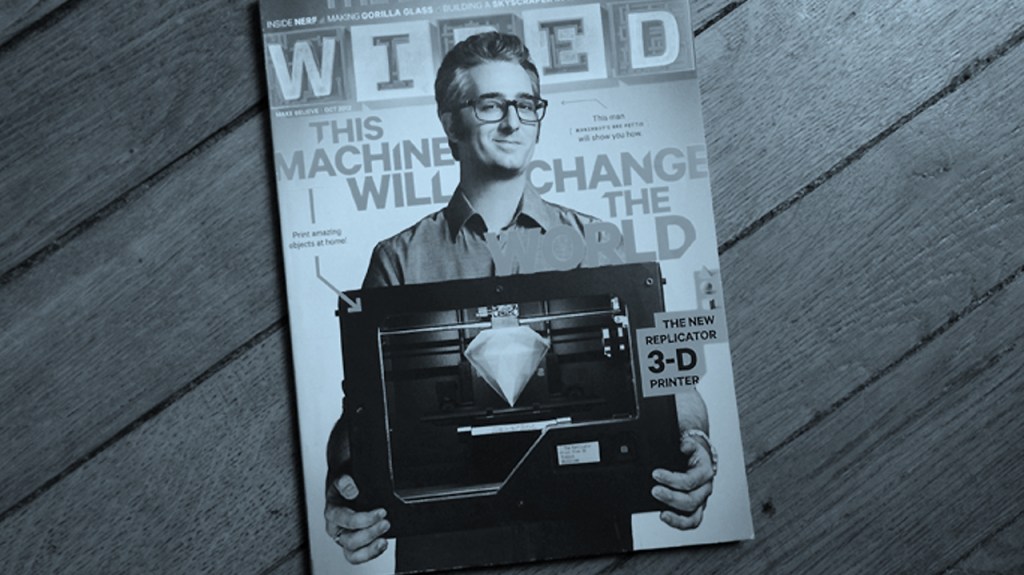
I am a subscriber of Wired magazine for years now, in october 2012, they launch an issue with a 3D printer on the cover. This issue tell us more than technique: 3D printer were a few months to become the next christmas gift (and not only for geek). That’s mean that 3D printing is gonna go mainstream…
Accessory makers already have a perfect field of expression. Look at these shoes non-workable whitout 3D techniques.


‘Morphogenesis’ 3D printed shoe by dutch designer Pauline Van Dongen

‘Strvct’ 3D printed shoe by Continuum, $900, here
3D printers is the next big thing for creatives, just look at Iris Van Herpen « Hybrid Holism » striking looks made with belgian-based atelier MGX by Materialise. The possibilities of creation seems to be infinite as you avoid some technicals difficulties due to seams and joining.


Iris Van Herpen, « Hybrid Holism » collection AW 2012/2013, read a review here
Technologies evolves quickly and actually 3D printers can create object containing different materials. Application fields seems endless (living cells, fooding, etc.)
Some people thinks that 3D printing is much more revolutionary than internet, I am not that far from their point of view. But as with internet, are we gonna create an other virtual world sometimes too far from certain realities and production system? Actually most of the shoes design are not really wearable, the materials are too weak, but things are going fast.
Internet help democratizes the information, today it’s a 5 mn process to launch a blog a talk about anything you want. Will 3D printing help the democratization of little productions? In a few years « we will be able » to print iPhone cases, kitchenware, bangles or with a giant 3D printer, our house!
Also, fashion design schools will find a tool to help their students at creating and exploring new designs.
Does 3D printing a next field for luxury brands, helping them create made to measure and exclusive furnitures using luxury materials?
E-artcrafting, a new kind of artcrafting and ‘savoir-faire’ is about to be created. As giant 3D printers are a subject of thinking by certains companies, imagine a luxury yacht with very exclusive (and crazy) design for very wealthy people…
« Your imagination is the limit ».
Also check, Nicolas Theil 3D-printed glasses here
Fashionclash is a plateform founded in 2009 by Branko Popovic, Laurens Hamacher and Nawie Kuiper where young fashion designers could show their work. It’s also a place where disciplines linked to fashion are invited.
Chers lecteurs, Elvira ‘T Hart is a young fashion designer graduated from the Rietveld Academy of Amsterdam. Born in 1988 from a mother graduated in interior design and a father « really good drawer », she naturally turn her life towards art, « they push me drawing » as she told me. « Now i draw all the time and my best are when i’m not really thinking of it! » The collection « Drawn by » of Elvira was shown as a little exhibition.

Hanging in the foreground, the drawings of Elvira ‘T Hart, in the background the outfits
What interested me in her work it’s the path from 2D to 3D. Most often it’s a sketch becoming an outfit, with Elvira’s work it’s like if we used a marker and draw directly on the dummy then « extract » the result. It’s a very graphic design result, all the garments are wearable. Elvira is a big fan of comic artists like Bill Sienkiewicz or Simon Bisley.

A laser-cut little black dress
As Elvira told me, her graduation collection was build on the same concept. She spend the whole year looking for the right technique (laser-cutting) to reproduce the visual effect and feelings of the drawings. After finishing her research she was not completely happy with it, « too many ideas in the collection ». So she decided to focus on her drawings (completely based) and made this collection.


Her garments leave a big part for our imagination. The quick sketches have an unfinished effect and she want to keep it for the garment, « it’s your imagination that complete the drawing or the garments », a drawing doesn’t have to be finished or completed to give the viewer an idea of that which is depicted. To see all her works check out her website.
Quelques notes prises hier soir lors de la conférence tenue par Anne Bony à l’Institut Français de la Mode sur le thème Art et design

Anne Bony, chargée du cours de design contemporain à l’IFM et spécialiste de l’historie du design.
– référence au divisionnisme et au baroque dans la création ci-dessous
– Retour du mobilier en fer battu, désir de revenir à l’époque des cavernes, à la pré-histoire.
– Mouvement « barbare », leurs créations sont d’ailleurs vendues à la galerie de leur éditeur « En attendant les barbares ».
– Décor du Palace, le nom du duo de designers est alors sur toutes les lèvres, collaborations avec Christian Lacroix…
– Voir aussi
Mobilier créé pour la maison de couture Christian Lacroix, 1987
– Avec Richard III, il réinvente le fauteuil club
– Voir aussi les fauteuils « Les Maitres » ou Louis Ghost, édités chez Kartell
– mixe tradition et modernité, au siège parisien de Van Cleef & Arpels il fait intervenir les métiers d’art du lambrissage et les staffeurs ornemanistes.
– marqueterie extraordinaire
– la figure humaine dans l’ameublement, « la sculpture fonctionnelle » (cf. Musée d’Orsay)
Penser aussi aux sites historiques où sont exposées des œuvres d’avant-garde, remember Jeff Koons à Versailles par exemple.
Une nouvelle génération de designers après Droog design et Lidewij Edelkoort, dont:
– inspiré de l’univers fantastique
– High tea pot (ci-dessous)
– Frog table (ci-dessous)
Et puis…
– collection Fantasy, pour Lladro
– extrusion du profil du chien… (ci-dessous)

Radi designers, Whippet bench, 1998
Le design, comme un effet miroir de l’art
– fondé sur le désir de poésie ouverte (c’est-à-dire non codifée) fusionnera ensuite avec différentes formes d’art (mobilier, vêtement, peinture, musique, photographie…), l’objet devient alors support d’expression.
– n’a de repercussions sur le mobilier qu’en République tchèque avec notamment Pavel Janak.
– Voir aussi

Pavel Janak, chaise cubiste, 1912
– Mouvement créé en 1913 par Duncan Grant et Vanessa Bell, fondé sur la littérature, la fusion entre art et ameublement et le refus de production en série.
– revue néerlandaise fondée sous l’impulsion de Piet Mondrian, elle avait pour but de réunir architectes et artistes, prôner un art simple fondé sur l’orthogonalité et la couleur simple.
– Voir aussi

Gerrit Rietveld, maison à Utrecht, meubles et architecture se croisent de maniere orthogonale, 1924
– est le résultat de la fusion en 1919, de deux écoles et concerne l’architecture, le design, la photographie, le costume.
– le travail de Marcel Breuer sur ces sièges est, pour lui, un travail sculptural. Contrairement à d’autres mouvements (les Omega Workshop par exemple) il y a dans ce mouvement un désir d’édition en série. Dans cette optique, Marcel Breuer utilise des tubes industriels, matériau peu cher.

Marcel Breuer, fauteuil club pliant (développement ultérieur du fameux premier modèle), 1927

Lena Meyer-Bergner, projet pour une couverture de chaise longue, 1928
– Fondé, entre autre, par Le Corbusier
– Fondé sur l’art, puis autour de la revue l’Esprit Nouveau, il fallait repartir de l’objet et de la réalité. Donner un aspect dépouillé et épuré.
– De ce premier mouvement naîtra le Mouvement Moderne.
– Ce mouvement soviétique réunissant les écoles d’architecture, de peinture et de sculpture, fut un centre important pour le constructivisme.
– Vladimir Tatline et la valeur utilitaire de l’art
– L’avant garde fait cause commune avec la révolution.

Vladimir Tatline, contre relief d’angle, 1915
– Grace à l’impression 3D, création d’éléments uniques avec des technologies super-innovantes (paradoxe de ces objets?)
– Prototypage rapide: idée d’artisanat contemporain (alliant gestes, dessin et réalisation), ci-dessous Front design, Tokyo (2007) crée des pièces uniques réalisées par la main des artistes dont le mouvement est capté par des caméras et qui sont protoypés immédiatement au sein même du musée. Fascinant !
Les artistes s’intéressent à l’objet
– Par la dimension artistique allouée par Oppenheim, la tasse couverte de fourrure en perd sa dimension fonctionnelle.

Méret Oppenheim, le déjeuner en fourrure, 1936
– travaille sur le (sur)dimensionnement des objets du quotidien.

Yonel Lebovici, Lampe « Fiche male » (H: 36 cm, L: 71 cm), 1978
– Consulter les catalogues des expositions passées sur le sujet: Design en stock, Palais de la Porte dorée (tentatives de hiérarchisation de l’objet, lien), Mobi Boom, Musée des Arts Décoratifs (lien), Patrick Jouin (Centre Georges Pompidou), Matali Crasset, Living wood, galerie Thaddaeus Ropac (lien), Design contre design, Grand Palais (lien)